

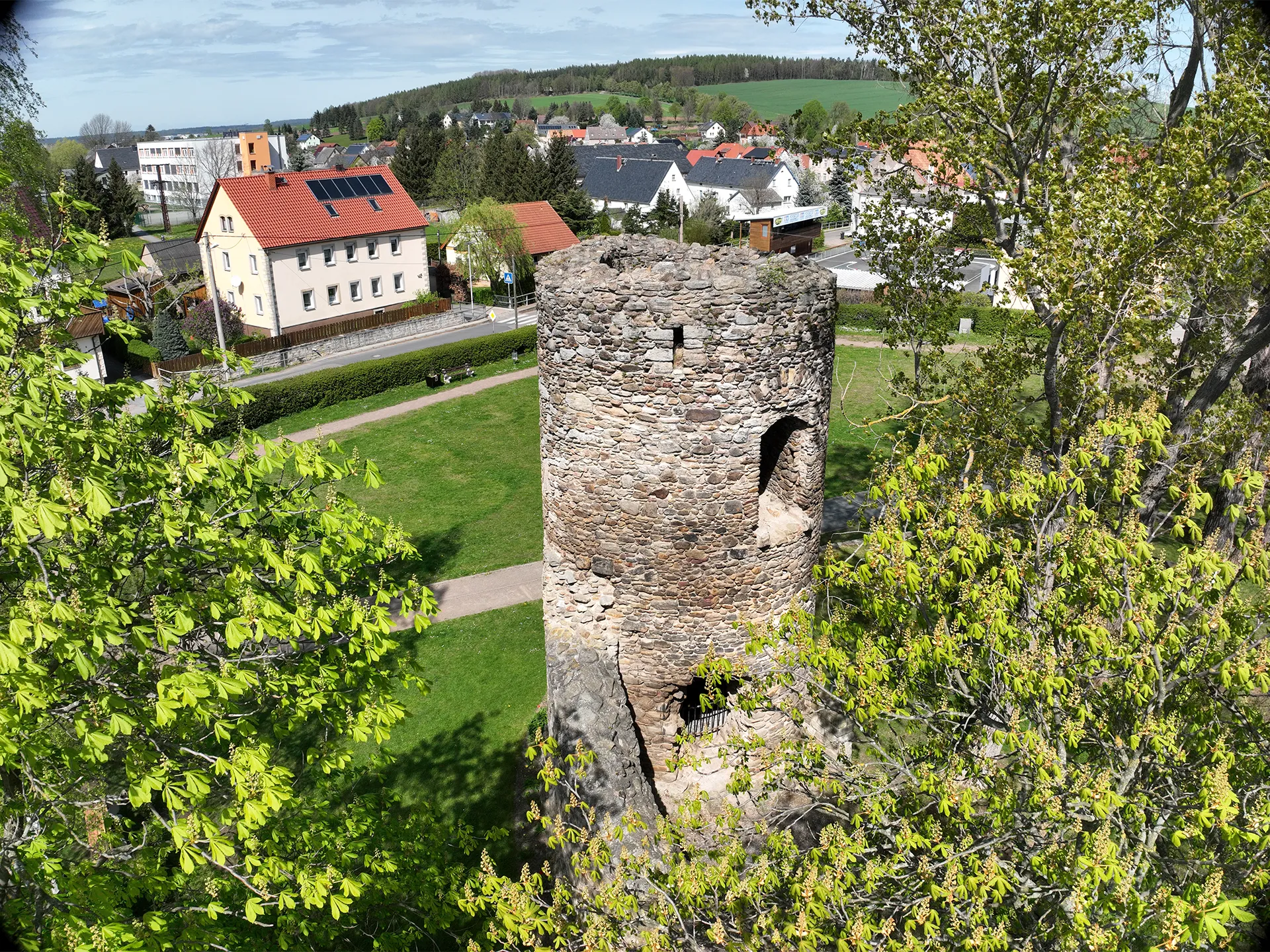
Station 1The Water Castle Ruins
-
Share on Facebook

-
Share on Whatsapp

-
Forward as e-mail

-
Copy link
Copied!

The castle ruins are the remains of an old moated castle from the 12th/13th century, which was built as a border fortress between the Margraves of Meissen and the Burgraves of Dohna. All that remains of the original structure today is a 12-meter-high tower with walls 1.5 meters thick and an 18-meter-long section of wall. The tower consists of a lower and upper floor and has several embrasures. The lower floor is covered by a domed vault, in the center of which it was once possible to enter from above through a square hole that still exists today.
The first inhabitants settled under the protection of the moated castle at the end of the 12th century. Contrary to some legends, there is no evidence that the complex was ever a robber baron’s castle. It probably served primarily to secure the important road between Freiberg and Dippoldiswalde. After the power of the Burgraves of Dohna waned in 1402 with the destruction of their ancestral castle in Dohna, the castle lost its strategic value. It is uncertain whether it was still inhabited after that or fell into disrepair.
The castle was once surrounded by a moat and a pond, which were converted into meadows in around 1840, with only a small remnant remaining. There was an oil mill or oil press nearby. The exact date of its disappearance is unknown. Until 1869, the ruins were much larger, but they were in poor condition. In that year, the neighboring outbuilding burned down (information board no. 23). During reconstruction, large parts of the ruins were used as building material without consideration. The further decay of the tower was later halted when, fortunately, the owner of the outbuilding, Wolf, who had owned part of it since 1888, had the tower rebuilt and the masonry repaired.
In 1998, the complex underwent further renovation. The ruins of the former moated castle are now a listed building. It is considered a landmark of the village and is an important piece of history for the inhabitants.